%201_1%201080.png)
How to do B2 First Speaking Part 3 and Part 4

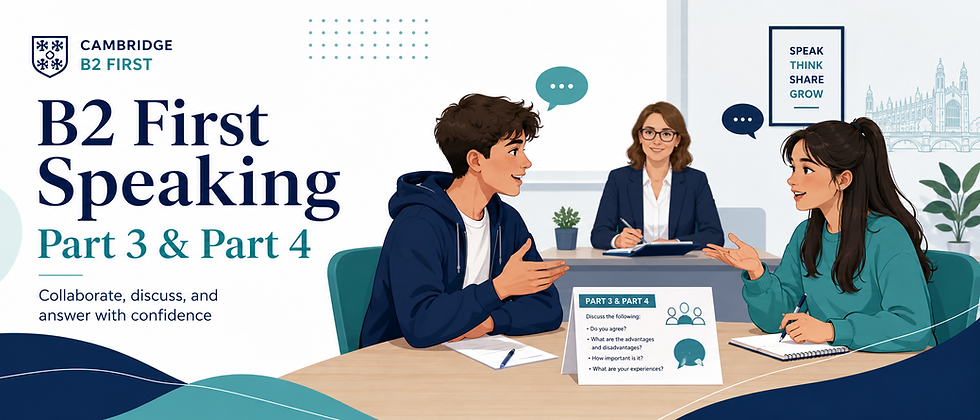
In the B2 First Speaking test, Part 3 and Part 4 are connected.
In Part 3, you speak with the other candidate. You are given a question and five ideas. Together, you need to discuss the ideas, make suggestions, agree or disagree, and try to reach a decision.
In Part 4, the examiner asks you some more general questions connected to the same topic.
The important thing to remember is this:
Part 3 is not a monologue. It is a conversation.
You are not just showing that you can speak English. You are showing that you can interact naturally with another person.
Speaking Part 3: The Collaborative Task

Part 3 is called the Collaborative Task.
To collaborate means to work together. So, in this part of the exam, you need to treat your partner like an equal.
You should:
speak to your partner, not the examiner
listen carefully to what your partner says
ask your partner questions
agree and disagree politely
react naturally
give your partner space to speak
try to reach a decision together
Imagine you are having a discussion with a friend or classmate in your own language. You would not talk for two minutes while the other person says nothing. You would listen, react, ask questions, and build the conversation together.
That is exactly what you need to do in the exam.

Timing in Speaking Part 3
In Part 3, you usually have:
15 seconds to look at the task
2 minutes to discuss the ideas
1 minute to make a final decision
In the first two minutes, you should discuss the different ideas. You do not need to talk about all five ideas in detail. In fact, it is usually better to have a good discussion about three or four ideas than to rush through all five.
In the final minute, the examiner asks you to decide something, for example:
Which idea is the most important?
Which option would be the best?
Which activity would be the least useful?
Do not decide too quickly
One common mistake is deciding too quickly. For example:
Candidate A: I think providing parks is the best idea because everyone can enjoy them.
Candidate B: I agree.
End of conversation.
The problem is that you still have time left, but nothing interesting to say.
A better strategy is to discuss some weaker options first. For example:
Candidate A: I don’t think security cameras would be the best solution. They might make people feel safer, but they could also make the city look dangerous. What do you think?
Candidate B: I agree. Tourists probably want to feel relaxed, not watched all the time.
Candidate A: Exactly. A nightclub might attract young people, but it wouldn’t be suitable for families or older tourists.
Candidate B: Good point. So maybe parks would be better because people of all ages can enjoy them.
This creates a much better conversation.
Useful phrases for Part 3
Asking your partner
What do you think?
Do you agree?
How about you?
Shall we move on to the next one?
What about this idea?
Giving your opinion
Personally, I’d say that…
As far as I’m concerned…
In my experience…
I tend to think that…
On balance, I’d say that…
Agreeing
I agree.
I totally agree.
I couldn’t agree more.
That’s a good point.
No doubt about it.
Partly agreeing
I agree to some extent, but…
I partly agree, although…
I can see your point, but…
That may be true, but…
Disagreeing politely
I’m not sure about that.
I see what you mean, but…
I’d say the opposite.
I don’t completely agree because…
Avoid very strong expressions like No way! unless the tone is clearly friendly and natural.

How to keep the conversation going
A good Part 3 answer is not just:
idea + opinion + stop
Try this pattern instead:
Opinion → Reason → Example → Question
For example:
I think offering free exercise classes could be useful because some people want to get fit but don’t know where to start. For example, a beginner class at school or work could help people feel more confident. What do you think?
This is much stronger because you give your opinion, explain it, give an example, and then invite your partner to speak.
What if my partner is shy?
If your partner is shy, do not panic.
Give them chances to speak:
What do you think about this one?
Do you agree with me?
Would you choose this option?
Wait a few seconds. If they still do not answer, continue naturally.
For example:
What do you think about free exercise classes? … Maybe they would be useful because people often need motivation.
The examiners will notice that you are trying to collaborate.
What if my partner talks too much?
If your partner dominates the conversation, stay calm and politely interrupt.
You can say:
Can I add something here?
That’s interesting.
I also think that…
Yes, and another point is…
Shall we look at another option?
Do not become aggressive. Just try to enter the conversation politely and show that you can interact.
Remember: you also have Parts 1, 2 and 4 to show your speaking ability.
Do I need to talk about all five ideas?
No.
You should try to discuss around three or four ideas well.
It is better to have a natural conversation with reasons, examples and reactions than to quickly mention all five ideas without developing anything.
The examiners are interested in the quality of the discussion and the quality of your English.
There are no “right” or “wrong” opinions. There are only good or weak discussions.
Speaking Part 4
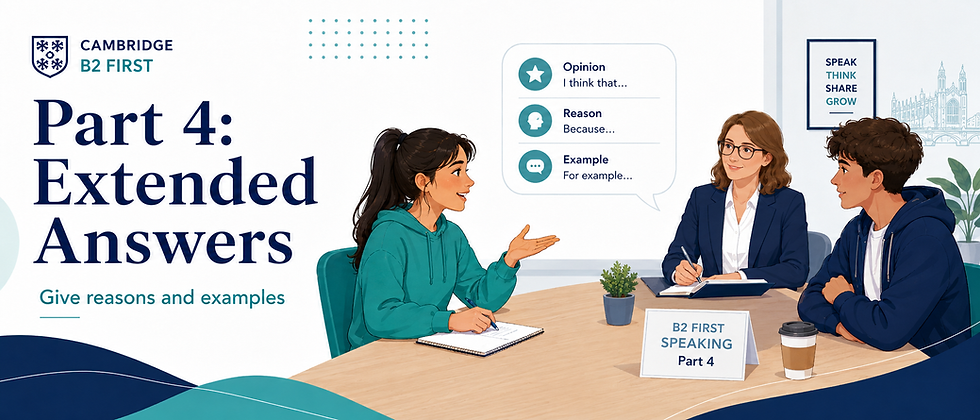
In Part 4, the examiner asks you more general questions connected to the topic from Part 3.
For example, if Part 3 was about health and fitness, Part 4 might include questions like:
Do you think you need to join a gym in order to get fit? Why?
Is it difficult for people to find time to exercise?
Do you have to spend a lot of money to be healthy?
Apart from exercise and food, what else can people do to stay healthy?
In this part, you speak more directly to the examiner, but you may also react to the other candidate’s ideas.
How to answer Part 4 questions
Do not give very short answers.
Avoid this:
Examiner: Do you think people need to join a gym to get fit?
Candidate: No, I don’t think so.
That answer is too short.
Use this structure instead:
Opinion → Reason → Example → Final comment
For example:
No, I don’t think people need to join a gym to get fit. The most important thing is to exercise regularly, and there are many ways to do that without spending money. For example, people can walk, run, cycle or do workouts at home. So, in my opinion, consistency is more important than going to a gym.
That is a much better B2 answer.
Useful phrases for Part 4
Personally, I think…
In my opinion…
I suppose it depends on the person.
There are two sides to this.
On the one hand…,
but on the other hand…
In general, I believe that…
Taking everything into account…
The reason I say this is because…
To put it another way…
What I mean by that is…


Practice Task 1: Health and Fitness
Part 3:
Here are some things that schools and workplaces can do to encourage students and employees to be healthier.
Talk to each other about why these might be good ways of encouraging people to be healthier.

Then decide:
Which way of encouraging students or employees to be healthier would make the most difference?
Part 4 practice questions
Do you think you need to join a gym or exercise class in order to get fit? Why?
Some people say that it can be difficult to find time to exercise or cook. What do you think?
Do you agree that you have to spend a lot of money in order to be fit and healthy? Why / why not?
Apart from exercising and eating well, what else can you do to stay healthy?
How important is it to choose a form of exercise that you enjoy?
What could you say to encourage someone who doesn’t enjoy exercise or healthy food?
Do you think eating meals at regular times helps you stay healthy?
How important is it to spend time outdoors every day?

Practice Task 2: Family and Friends
Part 3:
Here are some activities that families with teenage children can do together.
Talk to each other about the advantages and disadvantages of doing these activities together.

Then decide:
Which activity is best for bringing families with teenage children closer together?
Part 4 practice questions
How important is it for people to spend time with friends rather than family? Why?
Is it important to spend time with friends individually rather than in a group? Why / why not?
Do you think eating together helps families get along well? Why?
Do you think it is important for friends to share the same values? Why / why not?

Practice Task 3: Education and Study
Part 3
Here are some activities that people learning English can do to improve their speaking skills.
Talk to each other about how these activities might help people improve their speaking.

Then decide:
Which activity would be the least helpful for people learning English?
Part 4 practice questions
What do you think the most important school subjects are?
What else should children be taught in school?
Are there some things you cannot learn at school? What kinds of things?
How important is physical exercise at school?
How important are academic qualifications?
Some people say it is impossible to get a good job without a university degree. Do you agree?
Can TV be a good educational tool? Why / why not?
Some people say you shouldn’t trust what you read on the internet. Do you agree?
Final exam tips
In Part 3:
Talk to your partner, not the examiner.
Do not describe the diagram like a list.
Do not decide too quickly.
Ask questions and react.
Discuss three or four ideas properly.
Listen carefully.
Look at your partner more than the paper.
In Part 4:
Give extended answers.
Use reasons and examples.
Do not memorise answers.
React naturally to the question.
Try to sound interested and confident.
Common mistake
Incorrect:
I think you will be agree with me.
Correct:
I think you will agree with me.
Or:
I think you will be in agreement with me.
But the first version is much more natural.



Comments