%201_1%201080.png)
B2 First Formal Letter or Email: How to Write a Formal Response

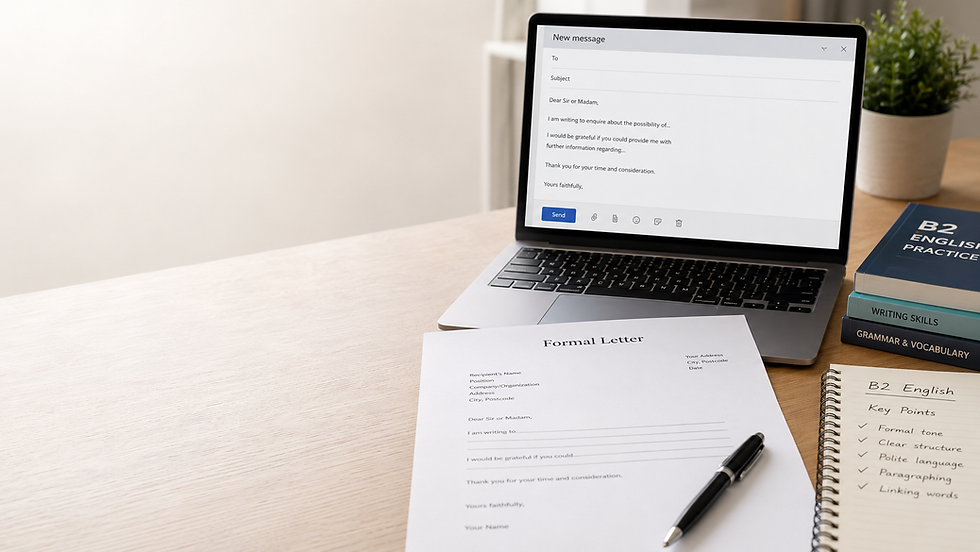
In Cambridge B2 First Writing Part 2, you may choose to write a formal letter or formal email.
This type of task usually asks you to write to someone you do not know personally, such as a course organiser, employer, company, manager or school director.
You should write 140-190 words.
A good formal letter or email should be clear, polite, well-organised and written in an appropriate formal style.
When Do You Need Formal Style?
You normally need formal style when you are writing to:
a company
a course organiser
an employer
a school or college director
a person you do not know personally
For example, you may need to:
apply for a job
apply for a course
ask for information
make a complaint
request help or clarification
explain a problem politely
If you are writing to a friend, you need an informal style instead.
What Do You Have To Do?
In a B2 First formal letter or email, you need to:
read the situation carefully
understand who you are writing to
use a suitable formal opening and closing
explain clearly why you are writing
answer all parts of the task
organise your ideas into clear paragraphs
use polite and formal language
write between 140 and 190 words
Example Exam Task
Read the task below.
You have seen this advertisement for a summer job.
Young people wanted
We are looking for enthusiastic, outgoing young people to work as team leaders in our summer camps, organising activities for children aged 7-12.
You must get on well with children and be good at sport.
Please apply saying why you are suitable for the job and what qualifications and experience you have that would be useful in the job.
Write your letter of application in 140-190 words.
Before You Start Writing
Before writing, ask yourself:
Question | Answer |
Who am I writing to? | The person responsible for applications |
What is the purpose? | To apply for a summer camp job |
What style do I need? | Formal |
What must I include? | Suitability, qualifications and experience |
How many words? | 140-190 words |
A Simple Formal Letter Structure
A formal letter or email usually works well with 4 paragraphs.
Paragraph 1 - Opening And Purpose
Say why you are writing.
Useful phrases:
I am writing to apply for...
I am writing in response to your advertisement...
I am writing to enquire about...
I would like to apply for the position of...
Paragraph 2 - Suitability
Explain why you are suitable.
Useful phrases:
I believe I would be suitable for this position because...
I am reliable, enthusiastic and hard-working.
I enjoy working with children.
I work well as part of a team.
I am confident organising activities.
Paragraph 3 - Experience And Qualifications
Give clear details and examples.
Useful phrases:
I have experience of working with...
I have helped to organise...
I have taken part in...
I recently completed...
I have always had an interest in...
I would be confident dealing with...
Paragraph 4 - Availability And Closing
Finish politely.
Useful phrases:
I would be available from...
I would be able to start immediately.
I would be grateful if you could consider my application.
I look forward to hearing from you.
Formal Openings And Closings
Use the correct opening and closing.
Opening | Closing |
Dear Mr Smith, | Yours sincerely, |
Dear Ms Roddick, | Yours sincerely, |
Dear Sir or Madam, | Yours faithfully, |
If you know the person’s name, use Yours sincerely.
If you do not know the person’s name, use Yours faithfully.
Formal Style: What To Avoid
In formal writing, avoid:
contractions: I'm, can't, I'd
very informal phrases: Hi, Cheers, See you
slang or casual language
phrasal verbs when a formal alternative is better
emotional or exaggerated language
very short, abrupt sentences
Instead of:
I’m writing because I want to ask for the job.
Write:
I am writing to apply for the position advertised on your website.
Informal To Formal Vocabulary
Informal | Formal |
ask for | request |
ask | enquire |
give | provide |
get | receive |
need | require |
fix | repair |
book | reserve |
changes | amendments |
more | further |
get in touch | contact |
Practice 2 - Rewrite In A Formal Style
Model Formal Letter
Read the model answer below.
Sample Answer
Dear Sir or Madam,
I am writing to apply for the position of team leader at your summer camps, which I saw advertised online. I believe I would be suitable for this job because I am reliable, outgoing and enjoy working with children.
I have experience of helping at a local sports club, where I assisted with activities for children aged eight to twelve. I also play football and tennis regularly, so I would be confident organising sports games and outdoor activities.
In addition, I have a B2 level of English and I recently completed a first-aid course at school. I would be available from the beginning of July until the end of August, including weekends.
I look forward to hearing from you.
Yours faithfully,
David MacFarlane
Why Is This A Good Formal Letter?
This answer works well because it:
uses a formal opening and closing
states the purpose immediately
answers all parts of the task
explains why the writer is suitable
gives specific experience
mentions useful qualifications
uses clear paragraphs
sounds polite and natural
Common Mistakes
Avoid these common mistakes:
using informal openings like Hi
forgetting the correct closing
using contractions such as I'm or I'd
writing too casually
not explaining why you are suitable
giving general claims without examples
missing one of the task points
writing fewer than 140 words
writing more than 190 words
Practice 3 - Plan Your Formal Letter
Use the summer camp task.
Before writing, make notes.
Paragraph | Your Notes |
Paragraph 1: Why are you writing? | |
Paragraph 2: Why are you suitable? | |
Paragraph 3: What qualifications or experience can you mention? | |
Paragraph 4: Availability and closing |
Practice 4 - Write Your Formal Letter
Now write your own formal letter of application.
Remember:
write 140-190 words
use a formal opening and closing
state why you are writing
explain why you are suitable
describe qualifications and experience
mention availability if relevant
check spelling and punctuation
More B2 First Writing Practice
For more help with Cambridge B2 First writing tasks, including essays, articles, reviews, reports and emails, visit the full writing tutorial section here:
Need Help Preparing For B2 First?
These free activities are a good start, but writing improves much faster when you get clear feedback and regular practice.
You can book a private lesson bundle with a mother tongue teacher to work on:
essays, reviews, reports, articles and emails
grammar and vocabulary accuracy
Cambridge B2 First exam technique
speaking practice and mock tests
personalised feedback on your writing
We are also developing a new B2 Writing Booster area with premium tutorials, downloadable
resources and AI-powered writing feedback.
For now, you can choose a private lesson plan here:
Final Advice
A strong formal letter is clear, polite and focused.
Do not try to sound complicated. Say why you are writing, answer the task points, give useful details and finish with an appropriate formal closing.
Formal does not mean lifeless. It means controlled, respectful and precise.


Comments